
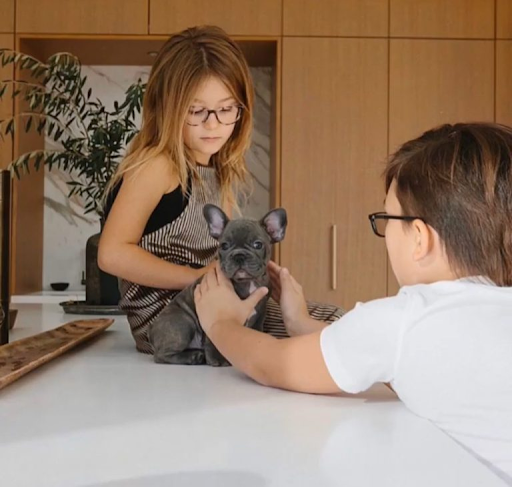
French Bulldog puppy socialization begins well before you bring your puppy home. When should French Bulldog puppies be socialized? The primary socialization period generally starts around 3 weeks and continues through roughly 12 weeks, with some research extending the sensitive period toward 14 weeks.
In this guide, you’ll learn what breeders should provide during the early weeks, what to continue after pickup, and which questions to ask before choosing a French Bulldog puppy.
What You Need Before You Start
Quick Answer: Before you evaluate any breeder’s socialization claims, know what the science actually says about timing and exposure.
What “socialization” really means for a French Bulldog puppy
Socialization is not simply letting a puppy meet people. It means controlled, positive exposure to new sounds, surfaces, people, and situations during the period when a puppy’s brain is most open to learning without fear.
The primary socialization window runs between 3 and 12 weeks of age, with effects on adult temperament extending toward 14 weeks, according to Canine Socialization: A Narrative Systematic Review, Animals.
A breeder’s actions during the first 8 weeks matter just as much as anything you do after you bring your puppy home, which is exactly why the timing question has two different owners: the breeder first and you second. Understanding both halves is what lets you ask sharper questions before you ever sign an application.
Step-by-Step: When and How French Bulldog Puppy Socialization Happens
Quick Answer: Socialization unfolds in four stages, and a buyer who understands each one can spot a properly raised puppy before signing a contract.
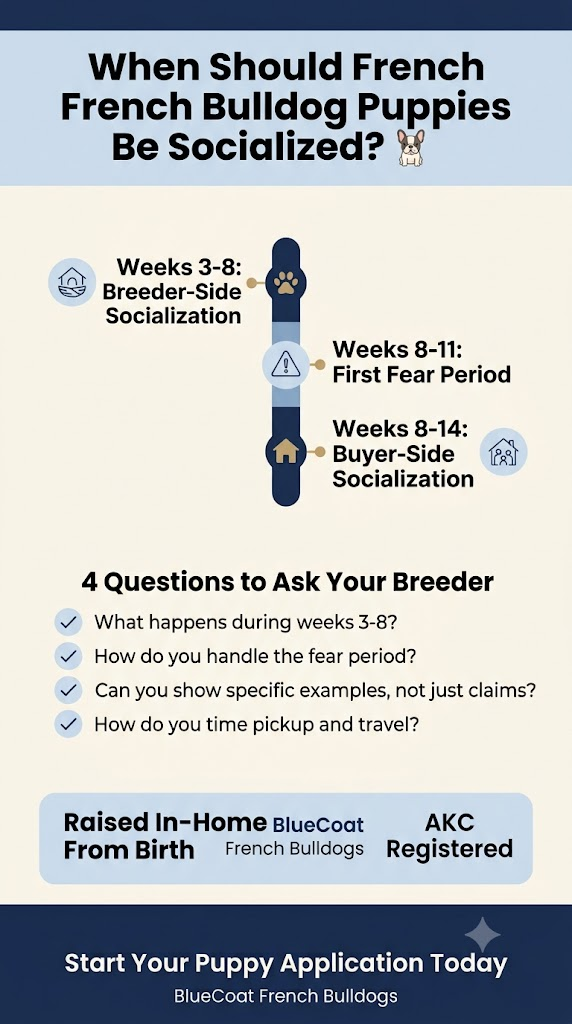
Step 1: Confirm the breeder’s week 3-8 socialization plan before you reserve
Ask the breeder what happens during weeks 3 through 8, while the litter is still in their care. A responsible breeder should describe specific exposures: different flooring textures, household sounds, gentle handling, brief separations from littermates, and short car rides once the puppy is old enough.
Vague answers like “they are very social” are not enough on their own.
Documented, age-specific detail is the difference between a real process and a marketing line, and it is worth asking the breeder to walk you through a typical week rather than accepting a general summary. If a breeder cannot describe specifics, treat that gap as a red flag rather than an oversight.
Step 2: Ask about the fear period between 8 and 11 weeks
Puppies typically go home between 8 and 10 weeks, right as they enter a documented developmental stage. Most puppies experience their first fear period at approximately 8 to 11 weeks of age, when a single frightening experience can leave a lasting impression, as per the AKC, Puppy Fear Periods.
Ask how the breeder times pickup and travel arrangements to avoid stacking multiple stressful events, such as vet visits and a flight, on top of this already sensitive window.
Step 3: Plan your own exposures for weeks 8 through 14
Once your puppy is home, the responsibility shifts to you. Short, positive introductions to new people, calm dogs, car rides, and everyday household sounds should continue steadily through week 14.
The goal is exposure without overwhelm, not forced interaction, according to the AVSAB, Socialization Is More Than Mere Exposure.
Keep each new experience brief and end it before your puppy shows any sign of stress, since just one bad encounter during this early stage can outweigh several good ones later.
Step 4: Ask the breeder to show proof, not just tell you
A trustworthy breeder can point to specific habits, not just a general claim. Ask for real examples: how puppies react to a vacuum, how they handle nail trims, or how they respond to a new person walking into the room.
This level of detail is the one thing most breeder websites skip entirely, and it is exactly what separates a documented, age-staged process from an assumed one you cannot verify before you apply.
When This Becomes a Job for a Trusted Breeder
Quick Answer: Once you know what proper socialization looks like, the next step is choosing a breeder who can prove they already did the work.
Signs a puppy was not properly socialized before pickup
Watch for a puppy that freezes, hides, or reacts with prolonged fear to normal household activity. A puppy that has never left a whelping box or met more than one type of person will need significantly more remedial work after adoption, and that risk falls entirely on the buyer.
How BlueCoat approaches in-home socialization from birth
BlueCoat French Bulldogs raise every litter in a home environment rather than a kennel, giving puppies regular exposure to household activity, family members, and everyday sounds from an early age. Each puppy is also AKC registered, providing documented pedigree and registration records.
Why timing matters this early in a litter’s life
Waiting until 8 weeks to begin any socialization effort is already too late to use the most receptive part of the window. Operating since 2015, BlueCoat has built its home-raised approach specifically around starting this process from the earliest weeks, not after a puppy is already crated in a kennel setting.
Frequently Asked Questions
Q1. At what age should French Bulldog puppies start socialization?
Socialization should start as early as 3 weeks, while the puppy is still with the breeder, and continue through at least 14 weeks after the puppy goes home, as per the Canine Socialization: A Narrative Systematic Review, Animals.
Q2. Can a French Bulldog puppy be socialized too late?
Socialization after 14 weeks is still valuable, but it takes more repetition and patience because the most receptive learning window has already narrowed.
Q3. What questions should I ask a breeder about socialization?
Ask what specific exposures happen between weeks 3 and 8, how the breeder handles the fear period around pickup, and whether they can describe specific puppy reactions rather than general claims.
Q4. How long has BlueCoat been breeding French Bulldogs?
BlueCoat French Bulldogs has been operating since 2015, building its in-home socialization approach around that experience.
Q5. Does nationwide delivery affect a puppy’s socialization?
A well-socialized puppy generally adjusts to flight-nanny travel with less stress, which is one more reason breeder-side socialization matters before delivery day.
Your Next Step
Understanding the right timing for puppy socialization helps you ask better questions before choosing a French Bulldog breeder. Look for specific information about early handling, household exposure, and the experiences provided before your puppy comes home.
If you’re looking for a French Bulldog puppy raised in a home environment, BlueCoat French Bulldogs can help you take the next step. Explore available puppies and complete the application to begin the process of finding your Frenchie.